INTRODUCTION
by David Edwin Gifford
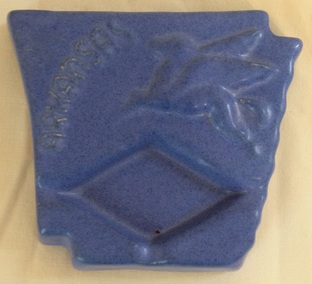
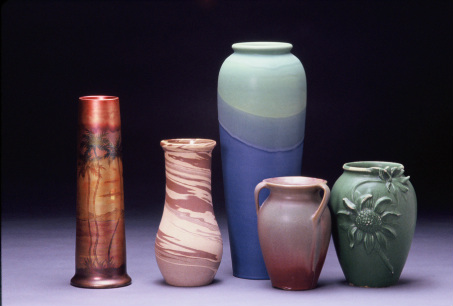
Arkansas art pottery was not a local development since Ouachita Pottery of
Hot Springs, Niloak Pottery of Benton, and Camark Pottery of Camden relied
heavily on experienced potters, ceramists, designers, and artisans from
outside the state, especially from Ohio. A network of itinerant potters
provided a continuous national connection that brought much of Arkansas's
art pottery into the mainstream of the American art pottery movement.
Although Arkansas had an abundance of clay, without these experienced
clayworkers, Arkansas's potters might never have been more than suppliers of
utilitarian ware for local and regional markets. Because these companies'
efforts resulted in commercially viable artistic wares with some
originality, their history deserves examination in order to understand
ceramic art in America.
Art pottery basically refers to the degree of individual attention given a
specific piece and to what extent that work was produced for the sake of art
and decoration. The American art pottery movement began with the 1876
Philadelphia Centennial Exposition, where American potters showcased their
wares. Prior to this time, most decorative art pottery was imported from
England. Scholars continue to debate whether American art pottery production
ceased in the 1920s or if it continued to the present. The difficulty lies
in the changing interpretation of what constitutes art pottery. Some
scholars argue that art pottery ceased due to the implementation of mass
production techniques, which replaced "artistic originality and creative
expression" with "quantity production and ease of manufacture." Other
historians insist that industrial effects were in place from the start and
that mass production had not necessarily negated artistic intent. This
exhibit suggests that the art pottery movement, using evidence of continuity
and "stylistic traditions," did not cease simply because of
industrialization.
The Arts and Crafts movement made a major impact on all decorative arts,
including ceramic wares, and was very influential in the development of art
pottery. Arkansans, like the rest of the country, were exposed to the
American Arts and Crafts and the developing art pottery movements through
different medium. In 1903, the Arkansas Federation of Women's Clubs promoted
one of the major Craftsman tenets, urging members to "sacrifice those things
in our home which we 'do not know to be useful or believe to be beautiful.'
Within a couple of years, Arkansas art pottery companies, with help from
out-of-state pottery employees such as Rookwood Pottery of Cincinnati and
other clay industries in Ohio, would be established and would begin making
an important contribution to the American Art Pottery movement.
Many in-state business and civic organizational leaders promoted
Arkansas's economic advantages and its many wonders, specifically its
mineral wealth, citing reports on the extent of Arkansas clay deposits "that
would truly surprise even the most enthusiastic believers in our mineral
wealth as well as command the admiration of the world." These clays were
"close to transportation, with unlimited fuel, coal, and wood;" advertisers
felt certain that "a great [clay] industry was sure to build up in the near
future and the manufacturing of porcelain [would] make our state famous."
While advertisers' claims that Arkansas was well supplied with excellent
clays for pottery manufacture might have been exaggerated, the state did
have workable clays already being used by many utilitarian ware
manufacturers. With investors and mineralogists investigating and developing
clay deposits throughout the American South, the creation of an Arkansas
ceramic industry seemed inevitable. By the 1900s, Newcomb Pottery in
Louisiana and George Ohr Pottery in Mississippi had begun. During the next
three decades, three Arkansas companies catapulted the state into the
national pottery movement, ultimately marking a unique and special place in
American material culture for Arkansas pottery.
The Arts and Crafts movement answered another need beside the desire for
beautiful things-it returned decorative arts to the realm of hand-made,
American goods. The rise of the Machine Age had created a backlash against
industrialization. It was, however, difficult for pottery manufacturers to
completely avoid industrial effects, since "art pottery already at an early
stage was the result of artists, artisans, and industrialists working in
collaboration." While hand-made goods were still valued, mass production
techniques became increasingly common with pre-1920 molded designs and
post-1920 hand-painted wares. The growth of mass production in the art
pottery movement resulted in less emphasis on artistic merit and more on
"some indication of being the product of aesthetic intent not to fall purely
in the category of functional or novelty ware . . . ." With the elements of
art, tradition, and industry, Ouachita Pottery, Niloak Pottery, and Camark
Pottery production, manufactured in Arkansas, had aesthetic intent and
extended beyond 1930, and therefore justifies the establishment of a new
timeline for the American art pottery movement.